16 Feb 2026
The Question of AI Detection
Kelly Webb-Davies looks at the current state of AI detection tools and lays out the AI Competency Centre's position on them

In my role as Lead Education AI Consultant at Oxford’s AI Competency Centre, I regularly receive emails that ask the question: I think my student has used AI in their assignment. Which AI detection tool should I use?
The tone of these messages is often anxious. Academics are trying to protect academic standards while navigating rapid technological change, and many are understandably looking for reassurance that there is a reliable way to identify AI-generated work.
As a linguist by training, and as someone whose work focuses on fairness in AI and education, I have examined these tools closely. Within weeks of ChatGPT’s public release, it was clear to me that AI detection would present fundamental problems — not simply technical limitations, but deeper issues grounded in how language itself works. Over the past two years, I have seen no evidence that meaningfully alters that assessment.
This is why our position at the AI Competency Centre is clear: we do not recommend the use of AI detection tools in academic decision-making.
The University of Oxford’s Position
The University does not currently endorse any digital AI detectors for use in academic decision-making. This position is based on both technical limitations and principles of procedural fairness. While these tools may evolve, their current capabilities fall short of what would be required to justify their use in determining student outcomes.
Current evidence indicates that the available software tools cannot reliably determine whether AI has been used and therefore should not be used to inform academic decision‑making. This position is sometimes disappointing to colleagues who are hoping for a technological solution to what feels like a technological problem. However, the evidence behind it is strong.
To understand why this position is necessary, it’s important to look carefully at what AI detection tools actually do, and what they cannot do.
Why AI Detection Fails
The Problem of Unverifiable Results
Turnitin's plagiarism (Similarity Score) checking software matches exact text to other exact text that exists somewhere else in another publication or online. That works to give you an idea if someone has copied something from somewhere else. But AI detection (including TurnitIn’s AI detection feature) is different. It's more of a statistical linguistic analysis of text, looking at the linguistic structure and deciding whether AI has written it or not. You're not comparing against evidence of something that actually exists—you're relying on an algorithm to make a statistical guess based on patterns.
The fundamental problem is that when you use these tools on real student work, you have no way to verify if they’re correct.
As a recent comprehensive analysis of AI detectors by Bassett et al. (2026) explains, “AI detectors rely on unverifiable probabilistic assessments. False positives are indistinguishable from genuine cases…there is no reliable way to verify the model’s accuracy against actual conditions.”
False Positives
Even if a detector claims a 1% false positive rate, this translates into enormous numbers of wrongly accused students when applied at scale.
The consequences have already been playing out. Recent reports from Australia reveal approximately 6,000 students were accused of using AI to cheat based on detection tools, with many cases later found to be incorrect (ABC News, 2025a; 2025b). These are real students facing real consequences: academic misconduct proceedings, damaged reputations, and the stress of defending work they legitimately produced themselves.
Worse still, a false positive looks identical to a true positive. There is no test you can run, no additional check you can perform, that definitively proves the detector was wrong which violates basic principles of procedural fairness (Bassett et al., 2026).
False Negatives
Another serious problem with AI detectors is the certainty of false negatives which is when AI-generated text fails to be detected. Detection can be easy to evade, especially with new features like ChatGPT and Gemini Canvas (this Canvas is not the Learning Management System (LMS) – this is a tool in the chatbots which allows for fine-grained text editing both directly and through prompting and buttons) which enable seamless human-AI collaboration.
One example I give in my AI detection workshop is that when I asked ChatGPT to write an entire email from scratch, the detector only flagged it as 15% AI-written. After changing just a few words—a couple of sentences edited for legitimate reasons—the detection score dropped to 0%. This shows how unreliable these tools are, even for text that was genuinely AI-generated.
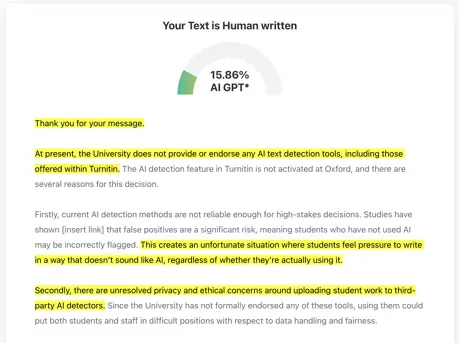
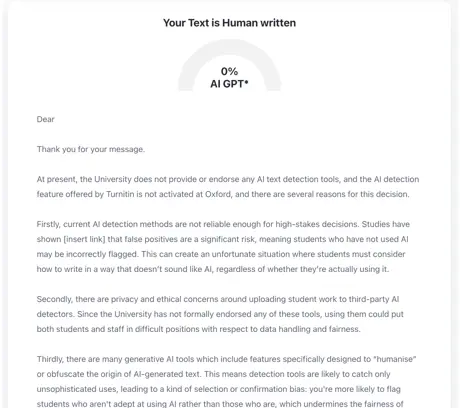
Services specifically created for this function are being advertised to students on social media: tools that claim to "humanize" AI-generated text so it can't be detected. AI detectors are an attempt to solve a digital problem, but then this digital problem (your text might get flagged) being met with more digital solutions to get around it.
What this means is that you're only going to catch students using AI badly. The result is that detectors give educators a false sense of security that they're identifying AI use, when in reality they're possibly missing a significant amount of AI-generated work created by informed AI users.
The Unwinnable Arms Race
Even if a detector performs well today, the result is likely temporary. Detection companies are effectively competing both with creative users who can easily adapt prompts or edit outputs to obscure stylistic AI traces, and with the major developers of AI models who have strong incentives and significantly greater resources to ensure their systems produce outputs that are not predictable or easily identifiable.
I explain in my AI Detection workshop AI companies want their models to sound natural and human, and regularly update them to improve this. They have exponentially more resources to achieve natural linguistic variability than detection companies have to identify it. Even a tool that appears effective at present can quickly become obsolete as soon as a new AI model is released, rendering previous detection advantages ineffective.
This isn’t a problem we can solve by choosing the “best” detector. It’s a fundamental imbalance that means detection is never likely to provide a sustainable solution.
The Reality of Hybrid Human-AI Writing
Students are increasingly using tools with built-in AI features they cannot disable—spellcheck, Grammarly, Google Scholar’s AI-powered search. At what point does assisted writing become “AI-generated”? Writing (which is already a technological invention - one used to represent language) exists on a spectrum of AI-assistance from simple spellcheck all the way up to complete text generation by a large language model. While it is tempting to place a boundary on what is permitted use on this scale, hybrid human-AI writing is becoming normalized, sophisticated tools are being developed to assist research writing, and to enforce a boundary we must be able to detect AI generated text.
Consider these scenarios:
- Scenario A: A student verbally dictates their own sophisticated ideas to an AI tool, which then helps with written phrasing, grammar and structure. The intellectual content is entirely theirs, even if the writing itself was AI-assisted. Is this AI or human writing?
- Scenario B: A student asks AI for ideas, arguments, and sources without critical thought, then manually rephrases and types them out themselves using their own writing voice. The expression is manual, but the thinking is absent. Is this AI or human writing?
The Harm of “Detection Anyway”
Bias Against Vulnerable Students
Students who face barriers to writing (such as those who speak English as an additional language, are neurodivergent, or have physical differences that affect writing) often find AI tools genuinely helpful for expressing their ideas. For many learners, these tools reduce linguistic, cognitive, or physical barriers and enable fuller participation in academic work. Attempts to infer AI use from language or writing style alone risk reinforcing inequities, as they may inadvertently penalise students who rely on such tools for legitimate support.
Additionally, the very things detectors (and humans, when they are attempting to find linguistic hallmarks of AI writing) identify as “AI-like”—formulaic structure, simple vocabulary, generic tone—are often features of developing academic writers. So-called hallmarks of AI-writing like “lack of specificity and analysis, verbose, excessively wordy, formulaic structure, generic tone” are features we see in novice writers who are still learning. We risk punishing students for being learners.
Case Study: When “AI Writing” Is Just Learning Academic English
A colleague at Oxford (who wishes to remain anonymous) recently shared with me her troubling experience with AI detectors. She is both a non-native English speaker and neurodivergent, and over the past two years, she has been using ChatGPT as a language learning tool: asking for synonyms to expand her vocabulary, requesting suggestions for academic phrasing, and learning the conventional structures of English academic writing.
This is exactly the kind of legitimate educational use AI tools powered by large language models excel at, and learning academic language conventions is not new to the AI era. When I taught Academic English, I regularly directed students to the Manchester Academic Phrase Bank which is a website providing lists of stock phrases for academic contexts. ChatGPT excels at doing essentially the same thing, but is trained on trillions of examples of standard English. Academic writing is meant to be formulaic. That's how disciplinary conventions work.
As my colleague used ChatGPT to learn, she noticed its suggestions became increasingly minor because her writing was improving and internalising these structures. Arguably successful language learning in action.
Then she tested her essays with Winston AI detector. Her earliest essay, written before using AI, scored 0% AI-generated. As her English improved through AI-assisted learning, the detection scores on her (entirely human-written) work climbed higher until it was eventually flagged as significantly AI-generated.
The detector couldn't distinguish between AI-generated text and writing by someone who had learned from AI. Her style naturally evolved to reflect patterns she'd studied the same way any writer's style reflects what they read and learn from.
She faces double vulnerability: as both a non-native English speaker and a neurodivergent writer, she is more deliberate and intentional about academic structure. These very qualities—careful paragraph construction, adherence to conventional patterns—are what detectors flag as "robotic" or "AI-like."
This is not cheating. This is language learning. As Bassett et al. (2026, p.3) predicted, "As exposure to AI-generated material becomes increasingly widespread, it is reasonable to expect that the linguistic patterns of human writing will shift […] It is therefore inevitable that some students will produce work that, despite being entirely their own, matches the statistical patterns detectors associate with AI generation." Detectors interpret successful language acquisition as evidence of misconduct.
The Self-Surveillance Trap
When students know their work will be run through detectors, they start writing defensively. Instead of focusing on expressing ideas clearly, they worry: “Is this sentence too perfect? Should I make it worse so it looks human?” I have heard students voice these worries during the student training sessions that I give in the university.
This fundamentally undermines the writing process. Students need to be able to think, draft, and revise freely, not perform “human-ness” for an algorithm. Part of becoming a good academic writer is learning to put yourself in your reader’s shoes and write clearly. But now there’s an additional layer: students must also worry that if their writing is too clear and correct, it might be flagged as AI.
Erosion of Trust
The use of detection tools sends a clear message to students: we assume you’re cheating unless proven otherwise. This adversarial approach damages the pedagogical relationship at the heart of education.
Students have expressed to me how distressing and discouraging it is to be falsely accused of using AI. Such accusations erode trust and can undermine students’ confidence in developing and expressing their own academic voice.
What Oxford Should Do Instead
Leverage Our Existing Strengths
Oxford is particularly well positioned to maintain confidence in its formative assessment systems, even as AI becomes more widely used. The tutorial system provides regular, face-to-face engagement where tutors can assess student understanding through dialogue which is something AI cannot easily replicate.
Rather than investing in unreliable detection software, we should lean into what makes Oxford education distinctive: knowing our students through sustained interaction.
Reframe the Question
The question isn’t “Did they use AI?” (which is unanswerable).
The question is “Did they learn?” (which good pedagogy and assessment design can encourage and demonstrate).
An assessment being compromised by undetectable AI use is a design problem, not a detection problem.
Structural Solutions
Instead of attempting to police tool use, my recommendation is to focus on structural changes. Danny Liu from The University of Sydney has developed a practical framework that acknowledges reality:
Lane 1: Assessments OF Learning
These validate achievement at key points. They must be:
- Supervised (in-person exams, vivas, presentations)
- Secure (AI cannot be meaningfully used)
- Integrated with the authentic skills students need
Lane 2: Assessments FOR Learning
These support development throughout the course. They should:
- Accept that AI will be used
- Scaffold appropriate use
- Focus on the thinking, not the text
This “Two-Lane Approach” provides a realistic framework for maintaining validity while acknowledging that unsecured, take-home assessments cannot be policed.
Focus on Process, Not Product
Rather than judging the final text, design assessments that evaluate:
- The thinking that went into the work (captured through in-class drafts, vivas, or presentations)
- The ability to explain and justify choices
- Development and iteration over time
The key is to make the intellectual process visible and assessable, not just the final (written) product.
The Bottom Line
AI detection tools fail on technical, procedural, and pedagogical grounds. They cannot reliably distinguish human from AI writing, they violate principles of fair process, and they create a climate of suspicion that undermines education. HOW students are using AI is much more important than IF they are using it.
The solution isn’t better detection. It’s better pedagogical and assessment design.
The onus is on us as educators to create assessments that provide evidence of learning, regardless of which tools students use to get there. It’s difficult work. But it’s the only viable path forward.
Oxford’s tutorial system and commitment to formative assessment already position us well for this challenge. Rather than chasing detection tools that cannot keep pace with AI development, we should invest in what makes Oxford education distinctive: knowing our students through sustained, meaningful interaction.
Find out more
For a deeper technical analysis of why AI detection fails:
“Heads We Win, Tails You Lose: AI Detectors and Education” by Bassett et al. (2026)
For practical guidance on assessment redesign:
University of Sydney:
“False Flags and Broken Trust: Can We Tell If AI Has Been Used?”
And
“The Sydney Assessment Framework”
Kelly Webb-Davies holds a regular workshop on AI detection. You can also watch a previously recorded workshop on our Canvas.
For support in redesigning assessment the Centre for Teaching and Learning offers bespoke workshops.
The AI Competency Centre is developing a model designed to structurally address the challenges of AI in written assessment while maintaining security, accessibility, and authenticity. The model will be piloted in 2026 and will be applicable across diverse contexts. For more information, contact kelly.webb-davies@oerc.ox.ac.uk.


