15 Jan 2026
Rethinking Robotics: From Intelligent Machines to Intelligent Environments
How intelligent does a robot really need to be? For Associate Professor Daniele De Martini, the answer is increasingly: less than we think — provided its environment is intelligent enough.

Testing multi-robot, multi-camera setups in a warehouse environment near Oxford
Daniele De Martini is Associate Professor in Mobile Robotics at the Oxford Robotics Institute (ORI) and the Oxford e-Research Centre (OeRC), University of Oxford, where he co-leads the Mobile Robotics Group with Professor Paul Newman. His research spans robotics and artificial intelligence, focusing on perception, localisation, mapping, and decision-making for autonomous systems. In recent years, his work has taken a distinctive direction, challenging long-held assumptions about where intelligence in robotic systems should reside.
From smart robots to smart environments
Traditionally, robotics research has concentrated on making individual robots ever more capable. Better sensors, faster computers, and increasingly complex algorithms allow robots to perceive and reason about the world independently. While powerful, this approach comes at a cost: robots quickly become expensive, difficult to scale, and hard to deploy widely.
During the COVID-19 pandemic, practical constraints forced Daniele and his group to reconsider this model. Unable to rely on large, heavily instrumented platforms, they began exploring a different idea — one that has since developed into what Daniele calls “robotic inversion”.
“The robot has very little brain inside,” Daniele explains. “We use what’s already in the building and what’s already available in the cloud.”
Instead of embedding perception and intelligence within the robot, the approach shifts those capabilities into the surrounding infrastructure. Cameras already installed in buildings, such as CCTV systems, provide visual perception. Cloud computing supplies scalable processing power.
The advantages are significant. One camera can support multiple robots, dramatically improving scalability. Hardware costs are reduced. And intelligence can be upgraded centrally, without modifying each robot individually.
Daniele and his team are currently testing multi-robot, multi-camera setups in a warehouse environment near Oxford, moving goods from one location to another.
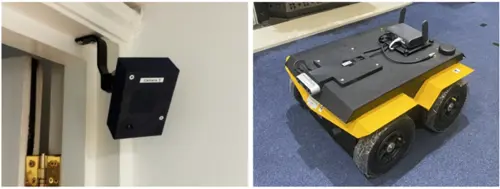
Robot-relay: custom camera and Jackal platform
But the experiments also revealed new challenges. Network latency and Wi-Fi dead zones caused delays that led to collisions — problems not with the robot itself, but with the infrastructure supporting it. This prompted a second, equally important research direction: how to design and instrument environments so that robots can operate reliably within them.
“It’s not only about how I make the robot move,” Daniele explains, “but how I place the cameras, where the Wi-Fi goes, how everything works together.”
From research to teaching: the MSc in Autonomous Robotics
This close integration of theory, experimentation, and deployment forms the foundation of the proposed MSc in Autonomous Robotics, due to launch in October 2026. The programme is explicitly shaped by the research culture at ORI and OeRC.
The MSc will cover the core fundamentals of robotics — including detection, segmentation, state estimation, sensing, and control — drawing on the same principles that underpin Daniele’s research.
Students will learn how robots understand where they are, what they are seeing, and how they should act. What sets the programme apart is its emphasis on hands-on, project-based learning. Alongside lectures, students will work in groups to turn theory into functioning robotic systems, under the supervision of active researchers.
Robotics as a unifying discipline
Robotics is very interdisciplinary. It can be a kind of glue that brings different subjects together in a very practical way. Daniele’s work intersects with data management, high-performance computing, computer vision, and intelligent infrastructure — areas where collaboration within the OeRC is already strong.
As robots increasingly move beyond laboratories and into everyday environments, scalability, robustness, and real-world integration will become ever more important. Through his work on intelligent environments and his role in shaping the MSc in Autonomous Robotics, Daniele De Martini is helping to define what the next generation of robotic systems — and roboticists — will look like.
Find out more
- Robot-relay: building-wide, calibration-less visual servoing with learned sensor handover networks
- Mobile Robotics Group website


