25 Mar 2026
Speeding Up the Future of AI
Dr Yishun Lu’s research is helping artificial intelligence models learn faster — and making advanced AI more accessible beyond big tech

Dr Yishun Lu presenting Beyond the Mean: Fisher-Orthogonal Projection for Natural Gradient Descent in Large Batch Training, AAAI, Singapore, 2026
Artificial intelligence is advancing at extraordinary speed. But behind every breakthrough — from facial recognition on smartphones to tools that summarise documents in seconds — lies an intensive and expensive process: training. Before an AI model can recognise an image or generate useful responses, it must be trained on vast amounts of data. For today’s largest systems, that training can take weeks or even months using highly specialised and costly hardware.
|
Dr Yishun Lu, a researcher at Oxford e-Research Centre in the University of Oxford’s Department of Engineering Science; is working to make that process dramatically more efficient. Earlier this year, Yishun presented his latest research at AAAI (the Association for the Advancement of Artificial Intelligence Conference) in Singapore — one of the world’s leading AI conferences. His paper tackles a fundamental question: how can we accelerate the training of AI models without compromising accuracy?
|
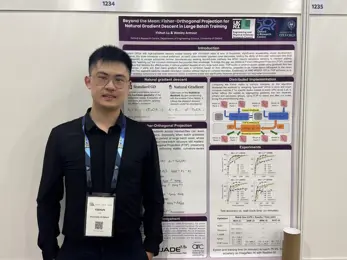 Dr Yishun Lu at AAAI, Singapore |
Smarter mathematics, not just more hardware
Most AI development today depends on brute computational force. Technology companies invest in vast arrays of high-end graphics processing units (GPUs), some costing tens of thousands of pounds each, to power model training. The prevailing strategy has been simple: add more hardware. Yishun’ research takes a different approach. Instead of simply increasing hardware,
Yishun is developing more advanced mathematical techniques — drawing on linear algebra and calculus — to make the training process itself more efficient.
“In simple terms, we are helping the model learn faster. The goal is to reach the same level of accuracy, but in much less time.”
He compares it to education. A typical student might need two years to master a subject. A gifted student might achieve the same result in a week. “We are trying to make AI models learn more like that — faster, but without losing performance.”
Lower costs, broader access
Faster training has clear economic benefits. Training large AI models consumes vast amounts of electricity and computing resources. Reducing training time lowers both energy use and financial cost.
At present, only major technology companies can afford to train cutting-edge models from scratch. Smaller companies often rely on systems developed by big tech firms because the barriers to entry are so high.
“If we reduce the training cost, more organisations could train their own models,” says Yishun. “They wouldn’t necessarily need the most expensive, frontier-level hardware.” That shift could make AI development more democratic.
Instead of depending on a handful of global providers, companies and institutions could build systems tailored to their own needs — whether in finance, engineering, healthcare or research.
Yishun offers a helpful analogy: “Right now, the largest AI models are like the British Library — huge, impressive, but not personalised. But what many organisations want is their own specialised library. Faster training makes that more realistic.”
Everyday impact
Although Yishun’s research focuses on the underlying training process rather than specific applications, its implications are far-reaching.
Image recognition — one of the core tasks used to evaluate AI systems — underpins technologies such as facial authentication on phones. Similar training methods power document summarisation, search tools and automated workflows.
When AI tools help draft emails, summarise reports or streamline administrative tasks, the visible convenience rests on extensive prior training. Making that training more efficient reduces costs throughout the system and speeds up improvement cycles.
“The benefit might not be obvious to the end user,” Yishun notes. “But faster training saves time and resources across industries. That ultimately benefits everyone.”
A Significant Career Step Presenting at AAAI marked an important milestone for Yishun. Originally trained in high-performance and scientific computing during his doctoral studies, he has recently transitioned into AI research as a postdoctoral researcher.
|
“This was my first paper at a top-tier AI conference,” he says. “It represents a successful transition into a new research area.” The conference brought together leading academics and industry researchers from around the world. Engaging with that community offered more than just the opportunity to present results — it provided insight into the rapidly shifting frontier of AI.
|
|
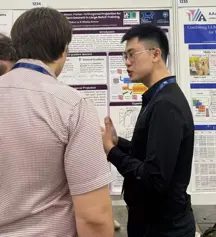
“A few years ago, AI was evolving year by year. Then it became month by month. Now it can feel like week by week,” he says. “Being at a conference like this helps you understand what really matters and where the field is heading.”
Beyond the hype
Despite the rapid pace of development, Yishun remains thoughtful about the broader picture. While media coverage often highlights AI’s power and speed, he points out that important challenges remain — including reliability and uncertainty.
"If you ask an AI system the same question ten times, you may get ten slightly different answers,” he notes. “That uncertainty is still a fundamental issue.”
Improving the training process is part of addressing those deeper challenges.
If more organisations can train and refine their own models, AI systems can become more specialised, better tested, and more reliable.
“Technology evolves step by step,” he says. “Something that once required enormous infrastructure can eventually become personal. That’s the direction we are moving in.”
And thanks to research like his, that future may arrive sooner — and be accessible to many more people.


